
Diplomarbeit kunstschule.wien Juni 2026
Self-image vs. External Perception: “Mein fremder Körper / My Body is a Foreign Object” (installation views)
To see the figure do come to the "Diplomausstellung", which opens on Thursday, 18 June with a vernissage at 6:00pm, and is open daily from 7:00pm to 9:00pm, Sunday 21 June from 10:00am to 6:00pm, and closes on Thursday, 25 June 2026 with a Finissage at 6:00pm.
Venue: kunstschule.wien, Liebknechtgasse 30-32, 1160 Vienna.
1 Introduction
My work „Mein fremder Körper“ (My Body is a Foreign Object) consists of a life size self portrait, a figure mounted on a plinth, in front of a backdrop of 2,90×2,90 metres depicting dysmorphic body shapes. The materials used include papier-mâché and my own handmade paper made of books meaningful to me. With this work I explore issues of self-image vs. external perception.
Self portraits have long played an important role in the fine arts. The earliest dated self portrait is Albrecht Dürer’s self portrait of 1484, he was thirteen at the time. „Dz hab Ich aws eim spigell nach mir selbs kunterfet Im 1484 Jar Do ich noch ein kint was. Albrecht Dürer“(1)
Another famous and prolific self portraitist was Vincent van Gogh, 45 have survived. Edvard Munch, Paul Gauguin (2), the sculptor Sara Bernard, Käte Kollwitz, Artemisia Gentileschi and Jenny Saville all produced famous self portraits at different stages in their lives (3). Some artists chose to include a self portrait within a major work (Gentileschi, Raphael, Michelangelo for example).(4)
My own approach has been strongly influenced by Maria Lassnig (5). Especially “Two Ways of Being (Double Self-portrait)” of 2000: “Zwei Arten zu sein (Doppelselbstporträt)”, and this (staged) photo of her painting herself taken in 1983. (6)
She is considered one of the most important representatives of European avant-garde art. After creating an early body of work that reflected Surrealism and Informalism, she later turned to self-portraits and focused on what she called “body consciousness.” In her choice of expressive media, Lassnig used not just painting, drawing and sculpture but also animated film. She wanted to depict what she felt. This inward-directed perspective made it possible for the artist to create new and different kinds of pictorial representation. Lassnig called her works “Körperbewusstseinsbilder” (Body Awareness Paintings), offering deeply personal insights into her own emotional world. With a mixture of abstract and in some cases deformed but realistic forms, she conveyed to the viewer a sense of her own physical awareness. (6, shortened, italics mine)
_____________________________
(1) Albertina Sammlungen Online, https://sammlungenonline.albertina.at/objects/86745/selbstbildnis-als-dreizehnjahriger
(2) Schneede, Uwe M., Die Kunst der Klassischen Moderne, CH Beck, 2007
(3) Hessel, Katy, The Story of Art Without Men, Vermillion, 2022
(4) Leinz, Gottlieb, Die große Zeit der italienischen Malerei, Lingen, 1988
(5) Lettner, Natalie, Maria Lassnig. Die Biografie, Brandstätter, 2017
(6) https://www.ruberl.at/en/maria-lassnig
***Page 1***
2 Motivation
In the summer of 2024 I began with the preparatory work for my diploma project in sculpture, starting with a series of full body self portraits in water colour and coloured pencil on paper, 80 cm by 120 cm. There are nine in total. I began the series in order to get a better sense of the shape and proportions of a body — and my body was the most easily accessible body to me. This one here below, me sitting and smoking, was the third and the first one I was satisfied with, the first two feel hesitant, lacking a certain confidence or boldness.
I followed up these drawings with small — 25cm to 30cm height — clay models. I made several from October to December 2024, enjoying the three-dimensional work very much, once again using myself as a model. It was not really a conscious choice to use myself as a model but simply the easiest choice at the time. But had I had the money to pay for a model I would have preferred that initially.
This has changed since and the practical considerations have been overtaken by a strong feeling of rightness about using my own body.
The small clay figures led to a half-scale sculpture, a sitting figure.I measured my body: limbs, torso, neck, head, hands, feet and divided the resulting measurements by two and used these numbers as a basis for the armature and shape of the figure. Is it a self-portrait? Yes and no. To my mind, the figure occupies a liminal (1) space: drifting between a self-portrait and a more general, even generic, representation of a female form. I covered it with sentences cut from pages of Simone de Beauvoir`s The Second Sex (French: Le Deuxième Sexe, 1949), the words clothing, covering and obscuring the female shape, shifting it towards representation as opposed to simply "being".
Using myself as body model, measuring and comparing it to the three-dimensional shape I created forced me to confront my own physicality, my proprioceptive senses, which are, I quote: "(...) generated as a result of our own actions. They include the senses of position and movement of our limbs and trunk, the sense of effort, the sense of force, and the sense of heaviness."(2)
_______________________________
(1) Definitions from Oxford Language: liminal 1. occupying a position at, or on both sides of, a boundary or threshold. 2. relating to a transitional or initial stage of a process.
(2) Proske U, Gandevia SC. The Proprioceptive Senses: Their Roles in Signaling Body Shape, Body Position and Movement, and Muscle Force. Physiol Rev 92: 1651–1697, 2012; doi:10.1152/physrev.00048.2011. (first visited 07/11/2025)
***Page 2***
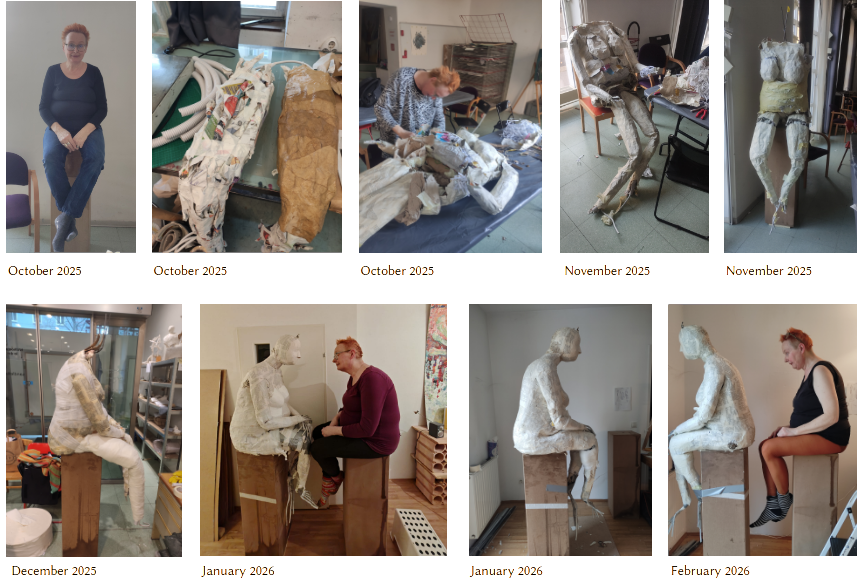
In October 2025 I began work on the armature and inner layers of the life size sculpture using flexible cable ducts and lengths of electrical cable in order to create volume without unnecessary weight.
This armature I padded with shredded paper wrapped in newspaper, using masking tape papier-mâché and finally layers of book pages glued on with wallpaper size to create a basic form.
After drying, I realised the whole shape was too bulky, which led to considerations of subconscious proprioception, and obvious discrepancies between how large I feel my body is, as opposed to how it looks to the outside observer, and also the objective facts of the measurements of my own body that I had taken. Despite measuring my shoulders, upper arms, back, lower back and buttocks the shapes were not only too wide but also too bulky overall. Also the angle of the upper thighs where they emerge from the torso was too shallow. To get a better sense of the true proportions I climbed on the plinth myself. Immediately I felt how sitting on the plinth influences the posture: the balancing required to stay up directly affects the position of the limbs and placement of the buttocks on the plinth.
So I cut the torso open and removed parts of the material beneath the "skin", an outer layer of book pages, to reduce the volume of the shoulders, breasts, stomach, upper back, lower back and buttocks. Afterwards I closed the cuts and shaped the figure anew, by wrapping it tightly with painter`s masking tape, which allowed me to compress the shape as I worked and to immediately check the achieved result without drying time.
I sit in the dark of my garden and attempt to feel the shape of my body: the torso feels bulky. Broad shoulders, a very wide back, large breasts and ample tummy rolls. Hips and legs are narrow, buttocks almost non-existent: I feel my hipbones where they connect with the hard garden furniture. In the dark it feels like the torso is out of proportion to the lower sections of the body. Thighs, lower legs, ankles and feet feel far away, progressively more shapeless the further distant they are from my head. I cannot sense my head, as if it does not exist. Only my eyes feel alive and active. When I try to picture myself, a mental image of a huge balloon shape emerges, doughy and bloated. My arms and legs feel detached. Huge feet. But my hands are small and close to my core.
This inner image is not borne out by the photographs and the measurements I took of myself. Another thought emerges: is this to be a self-portrait, shaped by my inner perception of my body shape? Or a figure true to measurements, objective fact? Or a self-image, an inner "selfie" warped by my self-perception made tangible, as selfies are warped: mainstreamed and "beautified" by some inner software in my phone`s camera as soon as the phone detects a human shape? Making the shape of the figure less bulky was an intuitive decision, a direct response to looking at it objectively.
One thing was clear to me: the finished work will not be a statue (3), but a figure (4). Language is funny there. Statue, with its close association of statuesque, a descriptor people have used to describe me, no doubt in an attempt to be polite, and static (5), as is in unchanging, not moving or reacting is not a description suited to me or my work. Whereas figure implies shape to me, an organic, evolving form, shrouded by incomplete self-perception.
To make this process visible, I decided I would include a representation of my body as I „feel“ it in order to contrast it with the figure. The figure is shaped according to my measurements and based also on the photographs, but at the same time I wanted to have a representation shaped by my mental image of myself.
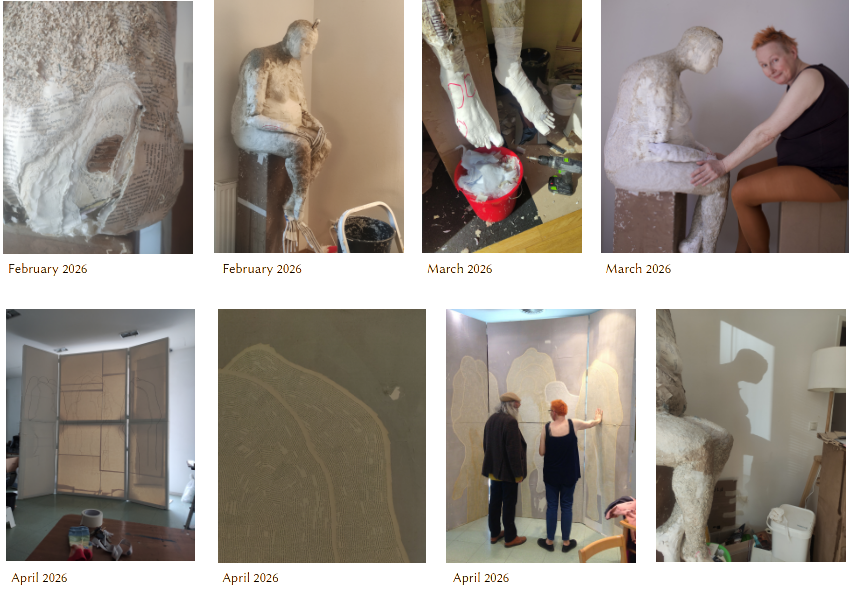
The result of these thought processes is the backdrop, the background behind the figure. The shapes I created on this back drop, using collage technique, represent my inner body: the shape I feel in the dark, the shadows it casts. And I decided that the figure would have glass eyes to emphasize that my eyes are the only part I consciously am aware of.
Use of eyes made of glass, and semi-precious stones, has a long tradition: “In the classical period, sculptors made free-standing bronze statues by hollow-casting their parts, then joining these components together by mechanical and metallurgical means. Cold chiselling then brought out details, especially in the hair, while blemishes and holes in the metal were patched. Although artists used different alloys of bronze for different effects, the metal was always left its original colour in statues—a golden brown that resembled suntanned skin. With inset eyes of stone and other materials, silver teeth, copper lips, and coloured borders on the drapery, these figures must have seemed astonishingly lifelike as they stood in the bright Mediterranean light.” (6, italics mine)
For some photographs of statues with eyes see the substack of James Lucas: https://www.james-lucas.com/p/the-piercing-gaze-of-greek-sculptures
_________________________________
(3) statue: a wooden, stone, metal, plaster, or other kind of sculpture of a human or animal figure, usually life-size or larger. Collins English Dictionary. Word origin C14: via Old French from Latin statua, from statuere to set up; compare https://www.collinsdictionary.com/dictionary/english/statue, last visited 08/11/2025
(4) You refer to someone that you can see as a figure when you cannot see them clearly or when you are describing them. In art, a figure is a person in a drawing or a painting, or a statue of a person. https://www.collinsdictionary.com/dictionary/english/figure, last 08/11/2025
(5) Static, adjective. Something that is static does not move https://www.collinsdictionary.com/dictionary/english/static last visited 08/11/2025
(6) page 44 in Norris, Michael et al, Greek Art: From Prehistoric to Classical: a Resource for Educators, 2000, The Metropolitan Museum of Art, New York
***Page 3***
3 Theoretical Background: Carl Rogers and his Theory of Creativity
My father, Werner Wascher (1939-2011), was a painter and a psychotherapist. He wrote about his own work: “By recording what I see, I permit myself a view of myself”. (1) Through him, my life and work became influenced by the theories of Carl R. Rogers (1902–1987), an American psychologist who was one of the founders of humanistic psychology and was known especially for his person-centred psychotherapy. He developed the person-centred, also known as client-centred, approach to psychotherapy and developed the concept of unconditional positive regard while pioneering the field of clinical psychological research. (2)
In „On Becoming a Person“ (1961, chapter 19, Toward a Theory of Creativity), Carl Rogers writes:
(...) "My definition then, of the creative process is that it is the emergence in action of a novel relational product, growing out of the uniqueness of the individual on the one hand, and the materials, events, people or circumstances of his life on the other" . (3)
And later in the same chapter he writes: “Somewhere here I want to bring in a learning which has been most rewarding, because it makes me feel so deeply akin to others. I can word it this way. What is most personal is most general. There have been times when in talking with students or staff, or in my writing, I have expressed myself in ways so personal that I have felt I was expressing an attitude which it was probable no one else could understand, because it was so uniquely my own…. In these instances I have almost invariably found that the very feeling which has seemed to me most private, most personal, and hence most incomprehensible by others, has turned out to be an expression for which there is a resonance in many other people. It has led me to believe that what is most personal and unique in each one of us is probably the very element which would, if it were shared or expressed, speak most deeply to others. This has helped me to understand artists and poets as people who have dared to express the unique in themselves.”
What Rogers describes is very much my own experience. People who look at my art have said that it resonates with them because they can find their own experience mirrored in my work. I believe this is because I put my own innermost feelings and observations on display, attempting to share what cannot be easily described. My works, created within the boundaries I set for myself through materials used, and intimately known to me like the familiar landscapes of childhood or the body of a beloved, become a vehicle through which common experiences are both recognized and shared.
I have always had a strong sense of the ridiculous. As Rogers puts it so much better than I can, “playing, exploring, wastefully spawning ideas”, using unsuited materials and bending them to my will appeals strongly to me.
I explore the limits of what I can do with paper and in the process I shred books – from literary works to trashy novels – thus violating ingrained childhood lessons of the sacredness of books, quietly enjoying the transgression. While initially I chose the books solely for their material properties when one of my instructors in sculpture class, Raimund Pleschberger, suggested that the actual content of the books could form an interesting component this unleashed new expressions of my inner life. It appealed to my sense of humour and playfulness to shape words, letters on pages into new, often whimsical meaning, or reduce them to undecipherable pulp.
In a later passage of the same chapter on creativity Rogers writes: “(...) the ability to play spontaneously with ideas, colours, shapes, relationships – to juggle elements into impossible juxtapositions, to shape wild hypotheses, to make the given problematic, to express the ridiculous, to translate from one form to another, to transform into improbable equivalents. It is from this spontaneous toying and exploration that there arises the hunch, the creative seeing from life in a new and significant way. It is as though out of the wasteful spawning of thousands of possibilities there emerge one or two evolutionary forms with the qualities which give them a more permanent value” (4)
Will Potter, another of my instructors in sculpture class, put it this way: “(…) your approach to making a self-portrait from bits of wood, plastic tubing, clay and papier-mâché? There's something ridiculous about attempting to express something so familiar as your own body in this way, but also something brave and heroic, in the sense of subjecting yourself to examination and also when the result transcends the jumble of materials and has a commanding presence in space.”(5)
His words summarize very well what my aim is with my art: to conquer and transcend my “jumble of materials” and use it to create expressions of my inner life which hopefully resonate with the viewers of my works, all the while enjoying a private joke hidden among the many layers of paper.
_____________________________________
(1) Towards Creativity: ein personzentriertes Lese- und Bilderbuch, Sandkorn 1994, quoted from page 14 of the English supplement to the book.
(2) American Psychological Association APA https://www.apa.org/about/governance/president/carl-r-rogers, last visited 11 May 2026
(3) Chapter 19, page 350, of Carl R. Rogers, On Becoming a Person: A Therapist's View of Psychotherapy (1961)
(4) Page 354-355, item C., ― Carl R. Rogers, On Becoming a Person: A Therapist's View of Psychotherapy, 1961
(5) Email correspondence, 14 May 2026
***Page 4***
4 Work Process, Techniques and Materials Used
My process consisted initially of collecting materials: paper, books, card board etc., and in a next step of shaping and building up form in papier-mâché, which – after drying – I reduce down and cut off, using knifes, rasps and sandpaper. I used the paper of books in various forms: shredded into very small particles of 2 cm by 2 mm, mixed with wall paper size to form a coarse papier-mâché; or ripped into small pieces for glueing on layers with wall paper size. For the top layer, the “skin”, I made my own paper from the shredded books, mixing the book material with pure cellulose to create a supple paper suitable as the last and only visible layer. This final layer was given a coat of wax and then polished.
The books for the collages and the handmade paper for the top layer were chosen consciously, the chosen books played an important part in my life. For the inner, invisible layers and papier-mâché I selected the books for their technical properties: high cellulose and lignin content, little to no additives, heavy paper as used for printing books during the 1950s to 1970s. This paper feels much like blotting paper, less like the paper used to print books on today, and dissolves easily. In total I used ca. 15 hard cover books with an average of 400 pages, the majority sourced from an “Offene Bücherschrank”, (a public place for donating unwanted books).
Feet, hands, face and other details were formed in foam clay, a light, quick-drying material based on PVA (Polyvinyl Alcohol).
For the figure itself I made an armature of flexible PVC (Polyvinyl Chloride) electrical cable conduits, electrical cables, metal rods, and cardboard. I then covered the armature with dozens of layers of papier-mâché and paper, in total about 2 cm thick, allowing for drying times in between, in order to achieve a surface as hard as wood, which I then sanded and covered with my own handmade paper made from book pages; the details of hand, feet and face were formed in foam clay, finally glass eyes set in. The glass eyes I used were made in Lauscha, Germany, in the 1950s.
Books used:
C. Ransmayr, Die Schrecken des Eises und der Finsternis. Brandstätter, Wien/München 1984 (chosen for author and content)
A. Golon, Angelique Series, various editions (chosen for paper quality)
Readers Digest Auswahlbücher, various editions (chosen for paper quality)
I built a backdrop from wood, a structure of six panels, covered with fabric, and then paper, size 2,90 metres by 2,90 metres, with hinges. On this I created a collage of book pages and grey paper. It shows the shapes of my body as I perceive it.
Books used, all chosen for content and biographical connection to my life:
C. Ransmayr, Die Schrecken des Eises und der Finsternis. Brandstätter, Wien/München 1984
C. Ransmayr, Morbus Kitahara. S. Fischer, Frankfurt am Main 1995
G. García Márquez: Hundert Jahre Einsamkeit, Aufbau-Verlag Berlin und Weimar, 1980
G. Heyer, Beauvallet, William Heinemann London, 1929
G. Heyer, Pistols for Two, William Heinemann London, 1960
***Page 5***
6 Conclusion
The labour of shaping, measuring, reducing then building up again, waiting for the papier-mâché to dry, rasping, sanding down and adding more layers is very meditative to me. As she takes shape, the figure feels very much alive to me and I look at it with fondness.
The journey of self portraiture which I embarked on the summer of 2024 has made me very aware of the huge gap between what my body feels like to me and how it actually looks to others. By including the collage backdrop depicting my inner visual concept of my body, this gap becomes accessible to the viewers and invites them to reflect on their own body perception.
I want to close by once more quoting Carl Rogers, as his words express so well what I feel:
What is most personal is most general. There have been times when (...) I have expressed myself in ways so personal that I have felt I was expressing an attitude which it was probable no one else could understand, because it was so uniquely my own…. In these instances I have almost invariably found that the very feeling which has seemed to me most private, most personal, and hence most incomprehensible by others, has turned out to be an expression for which there is a resonance in many other people. It has led me to believe that what is most personal and unique in each one of us is probably the very element which would, if it were shared or expressed, speak most deeply to others. (1)
To see the final figure do come to the "Diplomausstellung", which opens on Thursday, 18 June with a vernissage at 6:00pm, and is open daily from 7:00pm to 9:00pm, Sunday 21 June from 10:00am to 6:00pm, and closes on Thursday, 25 June 2026 with a finissage at 6.00pm.
Venue: kunstschule.wien, Liebknechtgasse 30-32, 1160 Vienna.
_______________________________________
(1) Chapter 19 of Carl R. Rogers, On Becoming a Person: A Therapist's View of Psychotherapy (1961)
***Page 6***
7 Bibliography
Eipeldauer, Heike, Medardo Rosso. Inventing Modern Sculpture (catalogue), Verlag der Buchhandlung Walther und Franz König, Köln 2024
Gleis, Ralph and Stief, Angela, Jenny Saville Gaze (catalogue) Hatje Cantz Verlag 2025
Hessel, Katy, The Story of Art Without Men, Vermillion, 2022
Leinz, Gottlieb, Die große Zeit der italienischen Malerei, Lingen, 1988
Lettner, Natalie, Maria Lassnig. Die Biografie, Brandstätter, 2017
Madesta, Andrea, Maria Lassnig: Körperbilder = Body Awareness, Snoeck, 2006
Norris, Michael, Carlos Picón, Joan Mertens, Elizabeth Milleker, Seán Hemingway, and Christopher Lightfoot. Greek Art: From Prehistoric to Classical: a Resource for Educators, 2000, The Metropolitan Museum of Art, New York
Rogers, Carl R., On Becoming a Person: A Therapist's View of Psychotherapy, Little, Brown Book Group, 1961
Schmid, Peter F., Wascher, Werner, Towards Creativity: ein personzentriertes Lese- und Bilderbuch, Sandkorn 1994, quoted from page 14 of the English translation supplement to the book.
Schneede, Uwe M., Die Kunst der Klassischen Moderne, CH Beck, 2007
8 Online Sources
Albertina Sammlung Online, https://sammlungenonline.albertina.at/objects/86745/selbstbildnis- als-dreizehnjahriger (first visited 7 November 2025)
American Psychological Association APA, https://www.apa.org/about/governance/president/carl- r-rogers, (first visited 11 May 2026)
Archaeology in Bulgaria and Beyond, https://archaeologyinbulgaria.com/seuthopolis-koprinka- bulgaria/ (first visited 15 May 2025)
Aware Magazine, https://awarewomenartists.com/en/magazine/voies-nouvelles-nouvelles-voix- les-femmes-peintres-et-lautoportrait-au-debut-du-xxe-siecle-en-europe/ (first visited 7 November 2025)
Collins English Dictionary, Online Version, https://www.collinsdictionary.com/dictionary/english (first visited 7 November 2025)
Lucas, James, Beauty is truth, Substack article, https://www.james-lucas.com/p/the-piercing- gaze-of-greek-sculptures (first visited 15 May 2026)
Oxford English Dictionary, Online Version, https://www.oed.com/dictionary (first visited 7 November 2025)
Proske U, Gandevia SC. The Proprioceptive Senses: Their Roles in Signaling Body Shape, Body Position and Movement, and Muscle Force. Physiol Rev 92: 1651–1697, 2012; doi:10.1152/physrev.00048.2011. (first visited 7 November 2025)
Viéville, Camille, "New Pathways, New Voices. Women Painters and Self-Portraiture in Early 20th Century https://awarewomenartists.com/en/magazine/voies-nouvelles-nouvelles-voix-les- femmes-peintres-et-lautoportrait-au-debut-du-xxe-siecle-en-europe/. (first visited 2 March 2026)
9 Illustrations
Page 3
Photograph of Maria Lassnig painting herself, taken in 1983 by Kurt-Michael Westermann, Galerie Ruberl, https://www.ruberl.at/en/maria-lassnig (first visited 2 March 2026)
Page 4
. Selfportrait Nr. 3, photo taken by Luise Wascher
Page 6
Detail of bronze head of Thracic King Seuthes III , glass and alabaster eyes, bronze lashes, work by Silanion or his circle during the 4th century BCE. Seuthes III ruled from ca. 331- ca. 330 BCE. Located in his tomb in Bulgaria.
Detail, head of the Goddess Hygeia, Eyes made of glass, Agate and Obsidian, with bronze eyelashes. By the Greek sculptor Attalos, 2nd century BCE. Eyes made of glass and agate, bronze eyelashes. Found in a temple in Feneos, Greece.
Detail of Charioteer of Delphi, 478 or 474 BC, Greece. Glass eyes, bronze lashes, statue discovered in Delphi.
Lucas, James, Beauty is truth, Substack article, https://www.james-lucas.com/p/the-piercing-gaze-of-greek-sculptures (first visited 15 May 2026)
Pages 10 and 11
Process photography, by Simon Wascher, Ludwig Daxer, Martin Köck, Luise Wascher and Simon Spitzer.
Mein Dank gilt Ludwig und Sabine Daxer
– ohne Euch hätte ich es nicht geschafft.